Media Release | 6 November 2026
CDD describes the expansion of restrictions once condemned by Rabuka as a major regression for democracy in Fiji, making section 115 far more restrictive than under the Bainimarama Government.
The Centre for Democracy & Dialogue (CDD) is shocked beyond disbelief that the Rabuka Government has not only retained the restrictions on civil society organisations under section 115 of the Electoral Act 2014, but has now passed legislation that extends their operation from approximately 45 days, as experienced during the last three general elections, to around eight months. The Electoral Commission officially declared the election campaign period open on 25 May 2026, and with the next general election potentially taking place as late as February 2027, affected civil society organisations could now face these restrictions for more than eight months, a staggering expansion of restrictions that Prime Minister Rabuka himself condemned while in Opposition.
CDD considers this a major regression for democracy in Fiji, particularly coming from a Government that promised to restore democratic freedoms and dismantle restrictive electoral laws.
What makes this development even more extraordinary is that Prime Minister Sitiveni Rabuka himself condemned section 115 while in Opposition.
Speaking in Parliament on 29 November 2018, Rabuka stated:
“Section 115 of that particular law limits voter education awareness by civil society organisations.”
He went further, arguing that voters were more confident and responsive to civil society outreach programmes than those conducted by political parties. He recognised that civil society organisations had an important role in educating voters about their rights and enabling them to make informed electoral choices without fear.
Eight years later, Rabuka is Prime Minister. Yet the very restrictions he condemned have not only survived two rounds of electoral amendments under his Government, but have now been extended in a way that makes them far more restrictive than under Bainimarama.
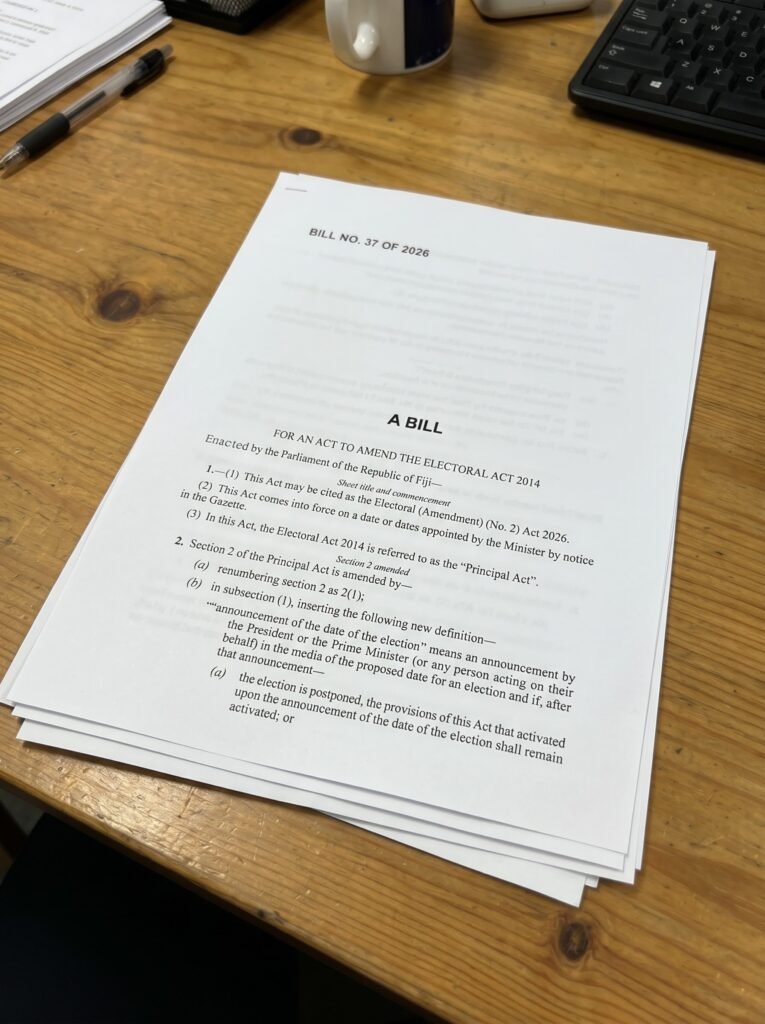
Under the previous section 115, restrictions on election-related campaigning by organisations receiving foreign funding or assistance were triggered by the announcement of an election date. The latest amendment replaces this with the entire official election campaign period.
The Electoral Commission declared the campaign period open on 25 May 2026. With the next election potentially taking place as late as February 2027, affected organisations could now face restrictions extending over more than eight months.
What activities are restricted?
Section 115 expressly encompasses activities such as:
- Organising debates;
- Conducting public forums;
- Holding meetings;
- Participating in interviews;
- Organising panel discussions; and
- Publishing material relating to elections or electoral issues.
These activities fall within the prohibition when they constitute election-related campaigning by organisations covered by the foreign-assistance restriction. The breadth of the provision creates serious uncertainty even for independent, non-partisan voter education, electoral research, public policy debates and analysis of electoral issues.
CDD finds it utterly preposterous that, in the months leading up to a general election, when citizens most need access to independent information and open public debate, the Government has chosen to potentially extend restrictions on precisely the activities that contribute to an informed electorate.
These restrictions do not apply only to foreign organisations. They can also affect Fijian civil society organisations receiving international development assistance.
Preventing improper foreign interference in elections is legitimate. But foreign funding of partisan political campaigns is fundamentally different from international assistance supporting independent voter education, public dialogue and democratic accountability. Conflating the two risks undermining the very electoral integrity these laws are supposed to protect.
As if retaining and expanding these restrictions were not enough, the latest amendment also seeks to exclude further judicial review of certain Electoral Commission decisions under section 115, raising serious questions about constitutional guarantees of administrative justice.
Government must explain the amendment
CDD calls on the Government to publicly explain the rationale for this amendment. Why was it necessary to extend the duration of restrictions that the Prime Minister himself previously condemned as undermining democracy?
These are not minor questions. The Government is making consequential changes to the democratic space in which the next general election will be contested, and the public deserves an explanation grounded in evidence rather than vague assertions about electoral integrity.
The Government has had nearly four years to correct the deficiencies of section 115. Instead, it has amended electoral legislation twice in 2026 without removing its fundamental restrictions on independent civil society participation. The latest amendment extends their application over a substantially longer period.
The law Rabuka condemned under Bainimarama has now been made even more restrictive under his own Government. CDD considers this a profound departure from the promise of democratic reform and a serious setback for civic freedoms in Fiji.
CDD calls on the Government to urgently reconsider the amendment, repeal the disproportionate restrictions on independent civic engagement under section 115, and preserve the right to judicial review of Electoral Commission decisions.
A democracy cannot thrive when independent organisations must question whether they can legally organise a debate, hold a public forum, conduct voter education or publish analysis of electoral issues during an election campaign.
The Prime Minister himself recognised this in 2018. The people of Fiji deserve to know why his Government is now taking the opposite approach.
ENDS