Joint Media Release | 13 November 2026
Civil society organisations warn that the Electoral Commission has expanded the definition of election campaigning so broadly that journalists, academics, political parties and civil society organisations could require official permission to engage in ordinary democratic activities.
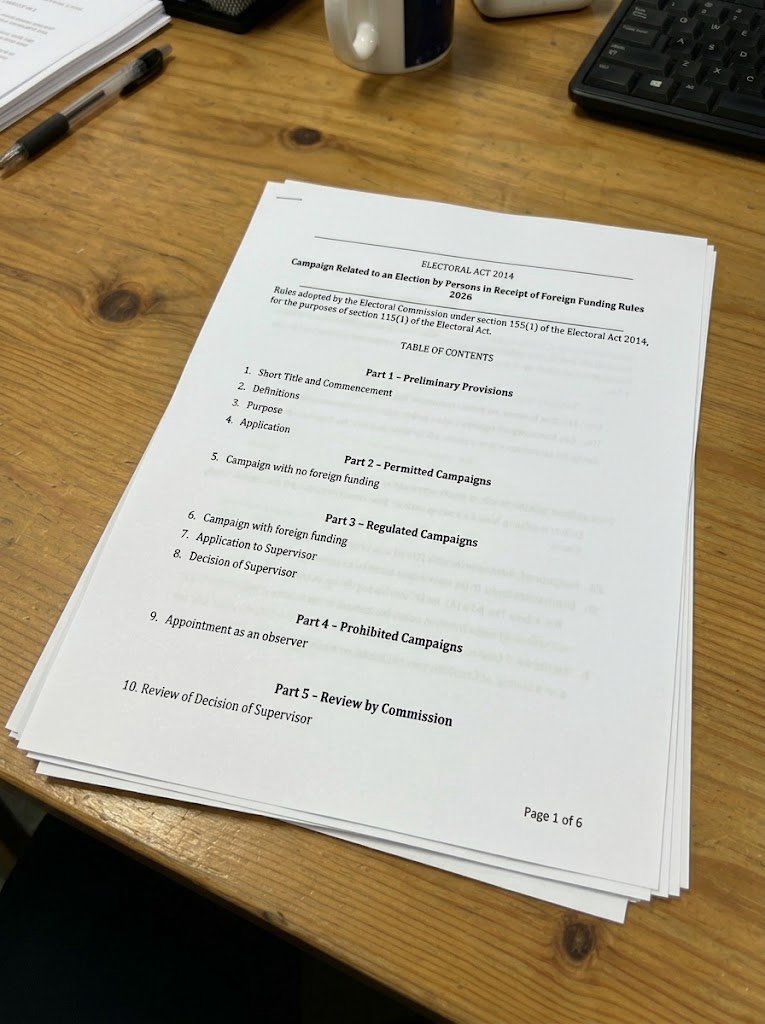
The undersigned civil society organisations strongly condemn the Campaigns and Foreign Funding Rules 2026 issued by the Electoral Commission (EC), which compound the serious problems created by the Government’s poorly conceived amendments to section 115 of the Electoral Act 2014. The Rules potentially place almost every discussion about an election under the regulatory control of the Supervisor of Elections.
Worse still, these restrictions are now tied to the campaign period, which began on 25 May 2026 and could extend until February 2027. A restriction that previously operated for approximately 45 days before an election could now potentially cover more than eight months, subject to the commencement of the amendments. The consequences are as absurd as they are alarming.
The Electoral Commission cannot rewrite the law
Section 2 of the Electoral Act defines campaigning by reference to promoting or opposing political parties or candidates, or activities undertaken for the purpose of influencing voting. Yet the Commission’s new Rules expressly include election-related debates, interviews, meetings, public forums and publications as campaigns “regardless of whether or not the purpose of the activity is to influence the voting at an election”.
Under this interpretation, simply discussing an electoral issue could constitute campaigning, even without any intention to influence voting. The Commission has effectively blurred the fundamental distinction between partisan campaigning and independent public-interest discussion.
Section 155(2) of the Electoral Act expressly prohibits the Commission from making Rules inconsistent with the Act or Constitution. While section 115 itself contains troublingly broad language, the Commission cannot use subsidiary Rules to expand statutory restrictions beyond what Parliament has lawfully authorised. We consider this definition legally questionable and potentially beyond the Commission’s powers.
Consider the absurd consequences
Section 115 applies broadly to persons and organisations receiving foreign funding or assistance, including their employees and representatives.
Under the Commission’s interpretation:
- A newspaper receiving foreign assistance for journalism training or equipment could require approval before interviewing a political leader or publishing election-related analysis.
- A political party receiving a lawful donation from a former Fijian citizen who now holds only foreign citizenship could potentially require permission before holding political meetings or giving interviews. Absurdly, the Rules require foreign-funded campaigns to provide balanced and neutral information. How is a political party supposed to conduct a neutral election campaign?
- A civil society leader contacted by a journalist for an urgent comment on ballot tampering or electoral integrity could have to seek permission before responding, potentially waiting seven days.
- A university professor receiving international research funding, or employed by a university receiving foreign assistance, could face uncertainty over whether approval is required before giving an election-related interview, notwithstanding the Act’s limited exemption for university forums and panels.
- A research organisation publishing independent findings on government performance, constitutional reform or electoral integrity could find its work classified as campaigning.
- A religious, women’s, youth or community organisation receiving foreign assistance could require approval to host discussions on poverty, the cost of living or political party policies.
These are not imaginary abuses. They are foreseeable consequences of the Commission’s own wording.
Almost every significant public policy issue, from healthcare and education to corruption, human rights and economic management, can become an election issue. Does that mean discussing these matters now requires the Supervisor’s permission?
The fact that independent information may influence public opinion does not automatically make its publication an election campaign. Civil society organisations conduct independent research, public education, electoral analysis and legitimate policy advocacy. We do not endorse parties or candidates, instruct citizens how to vote or conduct partisan campaigns. Our purpose is to inform citizens, scrutinise institutions and contribute to public debate. These are fundamental democratic functions.
The law cannot be selectively enforced against civil society
The Government and Electoral Commission cannot restrict civil society while permitting other organisations falling within the same statutory wording to undertake equivalent activities without approval. Such arbitrary enforcement would raise serious constitutional concerns about equality before the law and freedom of expression.
Nor would selectively targeting civil society be easy to justify as a measure against foreign electoral influence. Media organisations can reach hundreds of thousands of voters, while political parties exist specifically to influence electoral outcomes. Many civil society organisations, by comparison, conduct relatively small public dialogues, research and community education.
If preventing improper foreign influence is the objective, how can restrictions targeting independent civil society be justified while comparable or more influential activities elsewhere remain unrestricted? Any such distinction would raise serious questions of necessity, proportionality and constitutional equality.
The answer is not to restrict everyone’s freedoms. It is to remove unjustified restrictions and regulate genuine improper foreign interference in electoral campaigns.
Why expand restrictions repeatedly criticised by international observers?
Perhaps most astonishingly, the Multinational Observer Group (MOG) raised concerns about section 115 following all three general elections under the 2013 Constitution.
In 2014, the MOG described the provision as “unduly restrictive” and recommended removing restrictions affecting foreign-funded organisations. In 2018, it again recommended reviewing section 115 and strengthening civil society participation. In 2022, it again raised concerns and recommended further review of section 115.
International observers repeatedly called for these restrictions to be reconsidered. Yet the Rabuka Government has moved in the opposite direction, potentially extending their application from approximately 45 days to more than eight months.
Why is the Government so determined to control who can speak about elections, what they can discuss and when? Which established democracy requires organisations to obtain advance permission from election administrators merely to conduct independent interviews, publish research or discuss electoral issues? What is the compelling justification for such extraordinary control over democratic discussion?
Democracy cannot operate on prior permission
The Commission claims its Rules facilitate civic participation. Yet even organisations proposing to finance an activity entirely from domestic funds must seek approval if the activity is classified as campaigning, and disclose foreign funding received over the preceding three years.
The Supervisor may take seven days to decide, while the Rules purport to exclude judicial review of the Commission’s final decision. Public debates, media interviews and urgent responses to political developments cannot be scheduled around bureaucratic approval processes.
How can civil society critically scrutinise the Electoral Commission or the electoral process when we must first seek permission from the Commission’s own Supervisor of Elections to undertake that very scrutiny? The very institution whose decisions, conduct and administration must be subjected to independent public scrutiny would effectively have the power to determine whether that scrutiny may proceed. This is a fundamental contradiction that should have no place in a democracy.
This extraordinary situation is the consequence of the Government rushing poorly drafted electoral amendments through Parliament without adequate consultation or scrutiny. The Commission has now compounded the problem through an expansive definition of campaigning that threatens ordinary democratic participation.
We call on the Electoral Commission to urgently withdraw and reconsider the Rules, particularly its definition of campaigning, and on the Government to repeal or substantially amend section 115 to protect independent, non-partisan democratic participation.
Freedom of expression is not a privilege that the Supervisor of Elections may grant or withhold. It is a constitutional right. A democracy in which journalists, academics, civil society leaders and potentially even political parties must seek official permission before discussing election-related matters is a democracy in serious trouble.
ENDS
Issued jointly by
- Centre for Democracy & Dialogue (CDD)
- femLINKpacific
- Fiji Council of Social Services (FCOSS)
- Fiji Women’s Rights Movement (FWRM)
- Social Empowerment and Education Programme (SEEP)
- Transparency & Integrity Fiji (TIF)