FOR IMMEDIATE RELEASE
30 June 2026
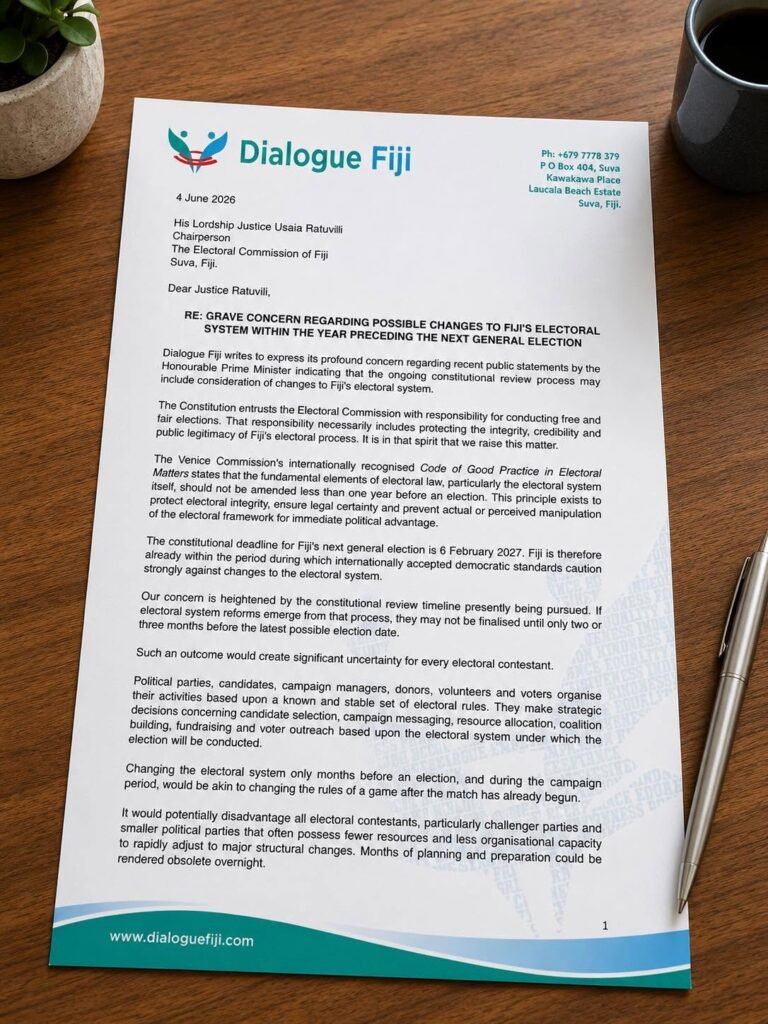
Dialogue Fiji has written to the Electoral Commission outlining concerns over the reported proposal to redesign Fiji’s ballot paper to include candidate names, photographs and party information, urging the Commission to carefully consider the practical, financial and administrative implications before proceeding.
Executive Director Nilesh Lal said while Dialogue Fiji supports continuous improvements to Fiji’s electoral system, any reforms must be evidence-based, practical and capable of being implemented without compromising electoral integrity or unnecessarily increasing costs.
“Electoral reform should solve genuine problems. Before introducing major changes to the ballot paper, it is important to establish whether the existing system is actually failing and whether the proposed solution creates more problems than it resolves.”
Dialogue Fiji’s submission highlights that ballot paper design is governed by well-established international principles, the most important being that the ballot itself should not confer an a priori advantage upon any candidate.
Dialogue Fiji noted that electoral research from around the world has consistently demonstrated that ballot design can influence election outcomes. Factors such as candidate placement, prominence, spacing and visual hierarchy have all been shown to affect voter behaviour.
“The current system, whereby candidate numbers are allocated through a public lottery, ensures complete randomisation. No candidate benefits from alphabetical order, party hierarchy or incumbency. Every candidate begins the election on an equal footing, which is a fundamental element of electoral fairness,” Mr Lal said.
Dialogue Fiji also questioned the practicality of producing a ballot paper containing candidate photographs and names under Fiji’s electoral system.
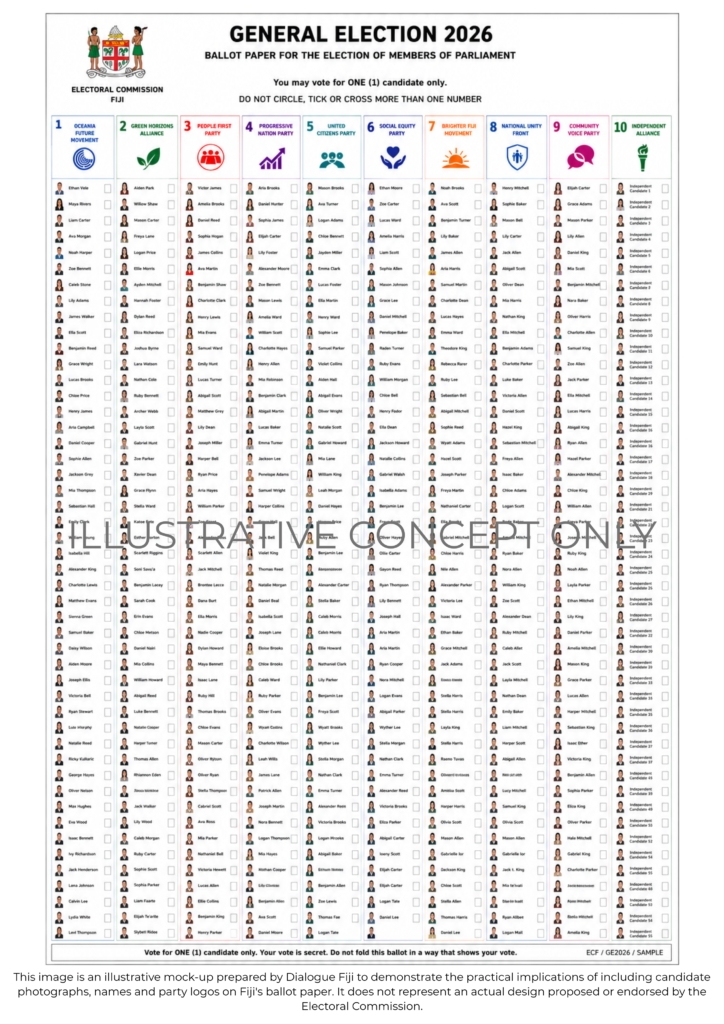
With Fiji electing 55 Members of Parliament from a single nationwide constituency for the next election, and with ten registered political parties currently eligible to contest the next election, the country could potentially have approximately 550 candidates on a single ballot paper if each party nominates the maximum number of candidates permitted under law.
Dialogue Fiji said accommodating 550 candidate photographs, names, party logos and candidate numbers on one ballot would likely require a ballot paper approaching or exceeding internationally recognised large-format paper sizes such as A0 (841 × 1189 mm) or even B0 (1000 × 1414 mm).
“At that point, we are no longer talking about an ordinary ballot paper. We are talking about something resembling a tablecloth.”
“We understand that similar proposals were reportedly considered before the 2014 General Election, when there were only 248 candidates, but were not pursued because Fiji lacked the printing capability to produce ballot papers of that size.”
Dialogue Fiji further warned that oversized ballot papers would create operational challenges throughout the election process.
“Polling booths would need redesigning. Voters would require more time to unfold, search, mark and refold ballots. Longer voting times mean longer queues. Counting would become slower, storage more cumbersome, transportation more difficult and ballot secrecy potentially more difficult to preserve if voters struggle to handle exceptionally large ballot papers.”
“The Electoral Commission appears to assume that photographs make voting easier. In reality, asking a voter to find one face among 550 photographs on a tablecloth-sized ballot is far more difficult than asking them to find a candidate number on a simple A4-sized ballot. The proposal risks replacing a simple search with an extraordinarily complex one.”
Dialogue Fiji also questioned the financial wisdom of the proposal.
“If ballot papers cannot be printed locally, secure overseas printing would likely become necessary, adding significant costs associated with specialised printing, international freight, insurance, customs clearance and secure transportation throughout Fiji.”
“At a time when the country faces significant fiscal pressures and ordinary Fijians are struggling with the cost of living, public money should be directed towards reforms that deliver measurable improvements to electoral integrity, not towards an expensive redesign of a ballot paper that is already functioning effectively.”
Dialogue Fiji said the Electoral Commission also appeared to be attempting to solve a problem that had already been addressed.
“The primary concern has always been that some voters may forget their preferred candidate’s number inside the polling booth. Dialogue Fiji proposed several years ago that official candidate information booklets displaying candidate photographs, names, party affiliations and candidate numbers be placed at every voting station. That practical proposal was subsequently implemented.”
“The current system already allows voters to verify candidate information before casting their vote while preserving a simple, manageable and neutral ballot paper.”
Dialogue Fiji also urged caution against making significant changes to the ballot paper so close to the next General Election.
“Changing the design of the ballot paper would require a comprehensive nationwide voter education programme. If voters are not fully familiar with the new ballot paper before polling day, there is a real risk that invalid ballots will increase.”
Mr Lal said stability and familiarity were themselves important elements of electoral integrity.
“Election administration should evolve where genuine problems exist. However, there is little objective evidence that Fiji’s current ballot paper is failing. Before embarking on what could become one of the most expensive and logistically complex ballot redesigns in Fiji’s history, the Electoral Commission should first demonstrate that there is a clearly defined problem which cannot be addressed through simpler, less costly alternatives.”
Dialogue Fiji has written to the Electoral Commission requesting that it reconsider the proposal and instead continue strengthening voter education and candidate information materials while retaining the current ballot paper format.
ENDS