PRESS RELEASE
27 April 2026
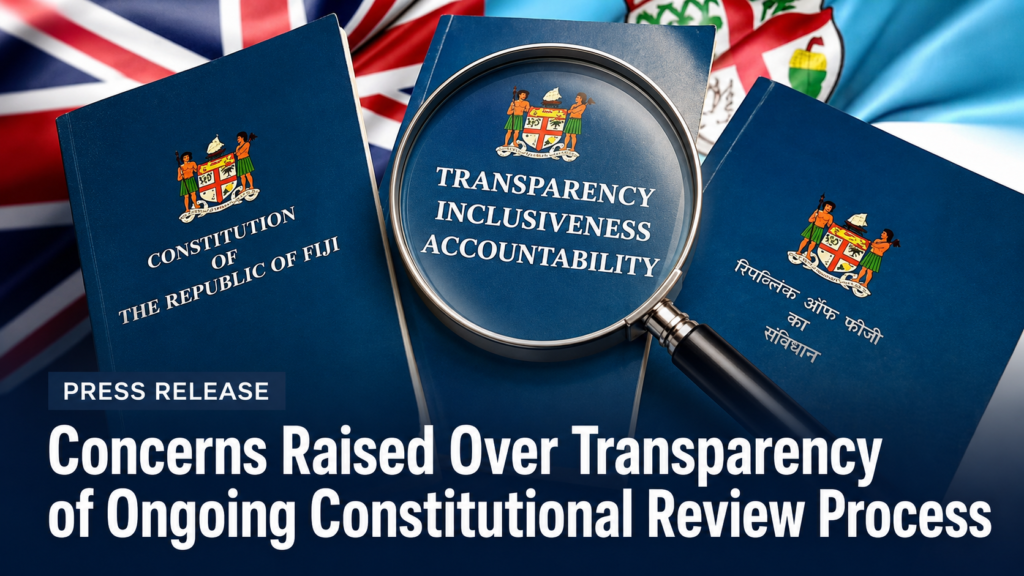
Dialogue Fiji has raised concerns regarding aspects of the ongoing constitutional review process, noting that improvements in transparency, inclusivity and structure are necessary to ensure the process effectively addresses concerns about democratic legitimacy.
The review process has been touted as a response to an alleged “democratic deficit” in the 2013 Constitution. Critics have long argued that this deficit arises largely from the manner in which the Constitution was formulated, rather than from its substantive provisions. Dialogue Fiji cautions that the current process, if not strengthened, is unlikely to cure that democratic deficit.
Executive Director of Dialogue Fiji, Nilesh Lal, stated that the standards being applied in the present review fall significantly short of what is required for a credible and legitimate constitutional process.
“Transparency is the cornerstone of any genuine constitutional review,” Lal said. “What we are seeing instead is a process marked by opacity. Consultations are being conducted behind closed doors, with no systematic effort to document or publish submissions. In today’s day and age, where it is easy and cost-effective to livestream proceedings and publish submissions online, this lack of transparency is unacceptable.”
Lal contrasted the current process with the work of Yash Ghai and the Constitutional Commission he led in 2012, which set a high standard for participatory constitution-making, not just in Fiji but also globally. That process involved extensive nationwide consultations and received over 7,000 submissions, all of which were publicly documented and made accessible online on a website that the Commission operated.
“The Ghai Commission ensured that every submission could be scrutinised by the public,” Lal noted. “This allowed citizens to verify which views were actually reflected in the final draft. That level of accountability is entirely absent in the current process.”
Dialogue Fiji noted that there is no website or centralised platform where submissions are being collected and published. As a result, the public is left to rely on selective media reporting to understand what is being presented to the Commission.
“How can the people of Fiji keep track of what is being submitted?” Lal asked. “How can submissions be systematically analysed, or verified, if they are not recorded and made publicly available?”
“The PM has said that the Constitution will reflect what ‘the people’ want. However, how can this be actually determined without a clear and transparent mechanism?” Lal said. “The people of Fiji are not a homogenous group. Without a systematic process for recording, publishing and analysing submissions, there is no objective way to determine what the people want, or how those views are considered and reflected in the constitution draft.”
Further concerns were raised regarding the accessibility and inclusiveness of the consultation process. Lal pointed out that many of the announced consultation venues are located in predominantly iTaukei villages and centres, potentially limiting participation from other communities.
Dialogue Fiji also highlighted structural weaknesses in the process, including the apparent absence of clear Terms of Reference or enabling legislation guiding the Constitutional Review Commission (CRC).
Lal noted that the Commission has reportedly been tasked with conducting a comprehensive review of the Constitution within a five-month timeframe.
“A comprehensive constitutional review cannot be properly undertaken in five months,” Lal stated. “In Fiji’s own experience, the Reeves Commission took two years, and the Ghai Commission took around one year. Internationally, 18 to 24 months is considered a realistic timeframe for comprehensive constitutional reform.”
“This is also consistent with comparative international experience,” Lal added. “South Africa undertook a two-year process between 1994 and 1996 with extensive consensus-building and public participation. Tunisia’s post-Arab Spring constitution-making process took approximately two and a half years, balancing urgency with inclusion. Kenya’s process, following its 2008 national accord, took about 19 months from reform process to referendum approval. These examples highlight the time and structure required to deliver credible and legitimate constitutional outcomes.”
Lal described the task given to the CRC as “unenviable,” noting that the compressed timeline and lack of structural clarity place significant constraints on the Commission’s ability to deliver a credible outcome.
Dialogue Fiji acknowledged that there are aspects of the current Constitution that would benefit from a proper and well-conducted review. However, the organisation cautioned that a rushed and opaque process will not address concerns about democratic legitimacy.
– Ends –