
← Module 2 · Elections and the Electoral System
An electoral system is the set of rules used to turn votes into elected representatives. It determines how voters make their choice, how votes are counted, who wins a seat in Parliament and, ultimately, which party or group of parties can form a government.
The basic idea is simple. People vote, the votes are counted, and a rule decides who is elected. Different rules can produce different results from the same pattern of public support.
For a candidate, the electoral system shapes the whole campaign. It affects where you campaign, whose support you need, whether you compete mainly against other parties or also against candidates from your own party, and how many votes you may need to win.
Voting is one of the main ways citizens exercise political power in a democracy. The electoral system determines how that right is translated into representation. An electoral system can affect:
No electoral system is perfect. One may produce a clear single-party government but leave many votes without representation. Another may represent more views but make coalitions more common. The important question is whether the system is fair, understandable and suitable for the country.
Electoral systems are usually grouped into three broad families.
Plurality and majority systems elect the candidate who wins in a constituency. First-Past-the-Post and the Alternative Vote are examples. Under First-Past-the-Post, the candidate with the most votes wins. Under the Alternative Vote, the winner must normally obtain more than half of the votes after preferences are counted.
Proportional representation systems aim to give parties a share of seats that broadly reflects their share of the vote. List proportional representation and the Single Transferable Vote are examples.
Mixed systems combine parts of the other two families. Some members may be elected from local constituencies while others are elected from party lists to improve proportionality.
Fiji has used three main electoral systems for parliamentary elections since independence:
Constituency and communal arrangements changed during these periods, so each system did not always operate in the same way.
First-Past-the-Post, often shortened to FPTP, is one of the simplest electoral systems. The country is divided into constituencies, and each constituency usually elects one representative. Voters choose one candidate. The candidate with the most votes wins the seat. The winner does not need more than half of the votes — only more votes than every other candidate.
For example, if Candidate A receives 40 per cent, Candidate B 35 per cent, Candidate C 15 per cent and Candidate D 10 per cent, Candidate A wins. Although A has the largest share, 60 per cent of voters supported someone else.
FPTP is easy to understand and count. It also creates a clear link between a representative and a local area, allowing voters to hold that member responsible for the constituency.
The main criticism of FPTP is that the national result can be highly disproportionate. A party can win many seats by narrow margins while another receives many votes spread across the country but wins few seats. This happens because votes are counted separately in each constituency. Votes for losing candidates do not help elect anyone and are often described as wasted votes.
FPTP can also encourage tactical voting. A voter may prefer a smaller party but believe it cannot win locally, and may then support a larger party simply to prevent another candidate from winning. Over time, this can make it difficult for smaller parties to grow and can encourage a two-party system.
A two-party system can be especially risky where political support follows a deep social or ethnic division. If each major community identifies with a different party, an election can appear to be a contest between communities rather than policies. This can make politics more confrontational and reduce the space for parties that seek support across communities.
This outcome is not caused by FPTP alone. Political leadership, institutions, campaign messages and social conditions also matter. However, winner-takes-all constituency contests can strengthen an existing division because there is little reward for a party that gains substantial support but repeatedly finishes second.
Safe seats are another concern. Where the same party regularly wins a constituency by a large margin, parties may focus their resources on a small number of closely contested seats. Supporters argue that FPTP often makes it easier for one party to form a stable government — that can happen, but a party may obtain a parliamentary majority without winning a majority of votes.
Fiji’s earlier use of FPTP cannot be separated from the communal system under which many seats were allocated to particular ethnic groups. The precise arrangements changed between the 1970 and 1990 Constitutions, but elections were largely organised through separate communal representation. This gave communities guaranteed representation, but it also encouraged parties and candidates to mobilise voters mainly through communal identity. Combined with winner-takes-all contests, it could turn control of government into a zero-sum struggle.
The Alternative Vote was introduced under the 1997 Constitution partly in response to these problems. It was hoped that preference sharing would encourage political parties to cooperate across ethnic lines and reward more moderate candidates.
The Alternative Vote, or AV, is a majority system used in single-member constituencies. It is also known as preferential voting or instant-runoff voting. Instead of choosing only one candidate, voters rank candidates in order of preference — 1 beside their first choice, 2 beside their second choice, and so on.
The count works in stages:
AV allows a voter to support a preferred candidate without necessarily losing all influence if that candidate is eliminated. A winning candidate can also claim support from more than half of the votes remaining at the final stage.
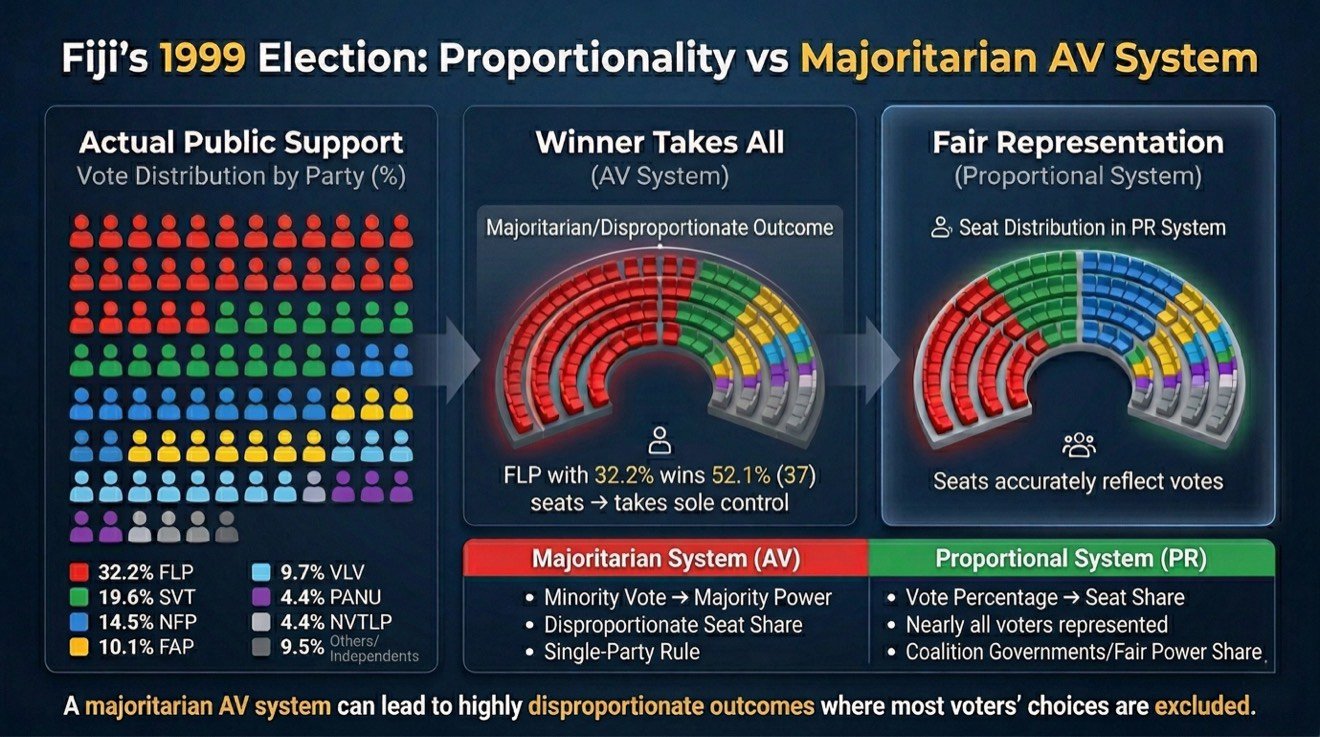
AV addresses one weakness of FPTP by requiring the winner to gain majority support after preferences are transferred. However, it is still a winner-takes-all system in each constituency. It does not guarantee that a party’s nationwide share of seats will reflect its nationwide share of votes.
The system can be harder to understand and count. The result may depend on several transfers, and a candidate who leads on first preferences can lose after others are eliminated. This can confuse voters who do not understand the process.
AV can encourage candidates to appeal to supporters of other candidates because they may need later preferences. Yet where parties control preference instructions, deals between party leaders may become more important than the voter’s own ranking. AV also retains safe seats and the disadvantages faced by smaller parties whose support is spread across many constituencies.
Under the 1997 Constitution, Fiji had 71 seats. Of these, 25 were open seats in which all voters could vote and candidates of any ethnicity could stand. The other 46 were communal seats reserved for particular communities: 23 for iTaukei, 19 for Indo-Fijians, three for General Electors and one for Rotumans. Each voter could vote in an open constituency and in the communal constituency for which the voter was registered.
The ballot offered two ways to vote. A voter could vote above the line for a party and accept its registered order of preferences, or vote below the line and rank individual candidates. If no candidate obtained a majority, the lowest candidate was eliminated and preferences were transferred.
The system was intended to encourage parties to exchange preferences across ethnic lines. In theory, a party would have an incentive to behave moderately so that supporters of other parties would give it their later preferences. In practice, the system was complex, and around one in ten ballots cast in 1999 was informal. Above-the-line voting also gave parties considerable control over preference transfers, which they could use to help an ally or block a rival, even when many voters knew little about the deal.
The results were also highly disproportionate. In 1999, the Fiji Labour Party won 32.2 per cent of the total votes but 52.1 per cent of Parliament. The NFP received 14.6 per cent on the same measure but won no seat. The election combined open and communal constituencies, so national comparisons require care, but the figures show how far seats could differ from overall support.
The system produced some cooperation between parties, but it did not overcome Fiji’s ethnic political divide. By 2006, the SDL and the Fiji Labour Party dominated Parliament. The SDL won 36 seats and the FLP won 31, leaving only four seats for all other parties and independents. The two main parties were widely identified with the two largest ethnic communities. Instead of creating a strong political centre, the system had helped produce a contest between two large blocs.
AV did not cause Fiji’s political tensions or coups, and no electoral system can by itself remove fear, prejudice or inequality. The experience shows that preference voting cannot create moderation simply because the law encourages parties to exchange preferences.
Proportional representation, or PR, refers to a family of electoral systems designed to make the distribution of seats broadly reflect the distribution of votes. In a perfectly proportional result, a party receiving 25 per cent of the votes would receive about 25 per cent of the seats. Results are not exact because seats cannot be divided, thresholds may exclude smaller parties and allocation formulas differ.
PR systems usually elect several representatives from the same electoral district. The district may be a region or the entire country. Larger districts generally produce more proportional outcomes because more seats are available for distribution.
PR can reduce the number of wasted votes and make it easier for smaller parties to win representation. This can produce a Parliament that reflects a wider range of views. It can also make coalition governments more common because one party may not win a majority of seats.
List PR systems use lists of candidates presented by political parties. The party’s total vote determines how many seats it wins. The main difference between closed and open lists is who decides which candidates fill those seats.
Under a closed list, the party decides the order of its candidates before the election. Voters normally vote for a party rather than an individual. If the party wins five seats, the first five candidates on its list are elected. Closed lists can help parties present a balanced team and can support measures such as alternating women and men on the list. However, party leaders have considerable power over who is placed in a winnable position.
Under an open list, voters can influence which candidates from a party are elected. In a fully open list, the candidates who receive the most personal votes within the party fill the seats won by that party. This gives voters more power over individual representation, but it also creates competition between candidates from the same party. Open-list systems vary. In some countries voters choose a party and may also choose a candidate. In Fiji, the voter chooses a candidate and that vote also counts towards the candidate’s party.
Fiji has used Open List Proportional Representation, or OLPR, since the 2014 General Election. The whole country forms one national constituency. Every voter has one vote and chooses one candidate. That single vote does two things:
Seats are allocated in two stages. First, the votes received by all candidates from the same party are added together. Parties that meet the national 5 per cent threshold take part in the allocation of seats. An independent candidate must also meet the threshold to win a seat. Seats are then distributed using the D’Hondt formula, which produces a broadly proportional result.
Second, each party’s seats are filled by its candidates. If a party wins six seats, its six candidates with the highest personal votes are elected. This explains why a candidate may receive more personal votes than a successful candidate from another party and still not be elected — seats belong first to parties according to their total support, then go to the leading candidates within each party.
For candidates, this means that every vote matters twice. It improves the candidate’s position within the party list and adds to the party total that determines how many seats the party wins. The number of seats in Parliament is reviewed before each general election. Fiji elected 50 members in 2014, 51 in 2018 and 55 in 2022.
Fiji’s OLPR system has produced results that are much more proportional than those under FPTP or AV. It has allowed a smaller party such as the NFP to return to Parliament and remain represented after failing to win a seat in 1999 or 2006 under AV. Because votes are pooled nationally, a party can gain representation from support spread across the country rather than having to finish first in a local constituency.
The national constituency gives parties a reason to seek support across Fiji. Elections alone cannot remove ethnic voting, but the law no longer divides parliamentary seats or voter rolls by ethnicity.
In 2014 and 2018, OLPR produced single-party governments. In 2022, no party won a majority. Four parties crossed the threshold, and the People’s Alliance, NFP and SODELPA formed a coalition government. The change of government was achieved peacefully through the election and the first sitting of Parliament — an important democratic development in a country where earlier transfers of power had been disrupted by coups.
There are also valid criticisms. Votes cast for parties below the 5 per cent threshold do not produce representation. A nationwide constituency can weaken the local link because no MP is elected to represent a particular town, province or community. In Fiji, however, this has been advanced as a reasonable trade-off for encouraging politics to move beyond ethnic and geographic divisions and focus more strongly on the national interest.
These strengths and weaknesses show why an electoral system should be judged as a complete design. Proportionality, ballot design, thresholds, constituency size, political finance rules, candidate selection and voter education all affect how the system works.
Under Fiji’s current OLPR system, a candidate is part of both an individual and a party campaign. You need enough personal support to rank highly among your party’s candidates, but your prospects also depend on the total votes received by your party. A candidate should therefore understand five basic points:
An electoral system does more than count votes. It shapes representation, party competition and the relationship between citizens and their elected leaders. Understanding it helps a candidate explain the election honestly, plan a lawful and effective campaign, and understand what a vote for that candidate will do.