
SUVA, 7 September 2026 — The Centre for Democracy & Dialogue (CDD) has urged Parliament to substantially amend the Political Parties (Registration, Conduct, Funding and Disclosures) (Amendment) Bill 2026, warning that several proposed changes could weaken key safeguards against the harmful influence of money in politics.
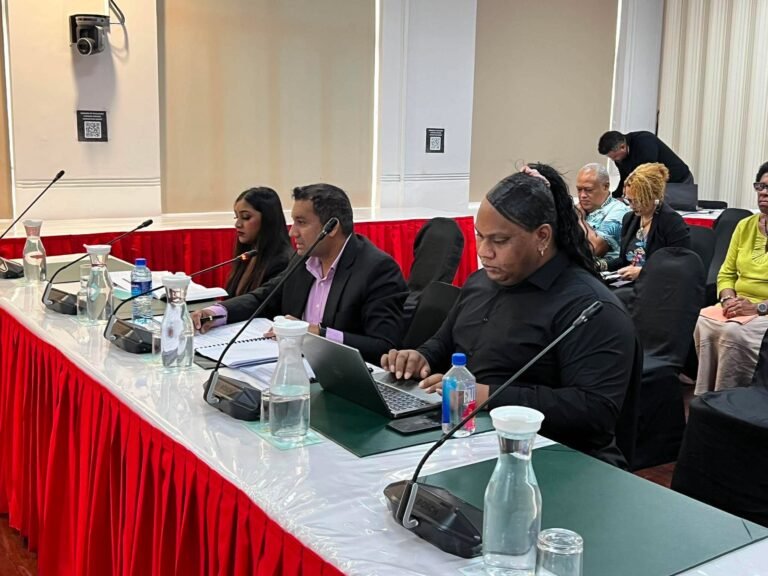
CDD presented its submission on Bill No. 31 of 2026 today to the Parliamentary Standing Committee on Justice, Law and Human Rights.
CDD CEO Nilesh Lal said the organisation supported meaningful campaign expenditure limits and more proportionate penalties, but strongly opposed proposals to abolish the existing $10,000 donation limit, permit unrestricted donations from foreign individuals and remove the existing financial disclosure requirements applying to political party officials and candidates.
“The purpose of political finance law is to prevent wealth from becoming political power and to make sure voters can see who may be financially influencing the people seeking to govern them. It is to prevent undue influence by wealthy donors,” Lal said.
Donation limits prevent one person from becoming financially dominant
Lal said there was an important public policy reason why democracies place limits on political donations.
“Donation limits are intended to prevent a political party or candidate becoming financially dependent on one very wealthy person,” he said.
“If a party needs contributions from hundreds or thousands of people, political influence is dispersed. If one person can pay for the entire campaign, financial influence becomes concentrated in the hands of that one person.”
Lal said this was fundamentally different from a campaign expenditure limit.
“A spending limit controls how much a party can spend. A donation limit controls how much influence one donor can potentially obtain. They deal with two completely different risks.”
Under the Bill’s proposed $3 million party expenditure ceiling, abolishing the donation cap could allow a single individual to provide the entire $3 million.
“A party could comply perfectly with the spending limit while being almost entirely dependent on one financier,” Lal said.
“That dependence does not have to involve someone saying, ‘I am giving you this money in exchange for this policy’. Influence can be much more subtle. It can affect who gets access to political leaders, candidate selection, appointments, policy priorities and whose interests are heard most strongly.”
CDD’s submission notes that International IDEA data show a continuing international trend towards regulating large political contributions by instituting donation caps rather than removing such controls. The Bill moves Fiji in the opposite direction from the rest of the world.
Bill would open political parties to unlimited foreign individual donations
CDD also strongly opposed the proposal allowing individuals who are neither Fijian citizens nor former citizens to make political donations without a monetary ceiling.
“In practical terms, a foreign billionaire with no citizenship connection to Fiji could potentially finance an entire political party campaign,” Lal said.
“Someone who cannot cast a single vote in Fiji could potentially contribute millions of dollars to an organisation seeking to govern Fiji. That should concern everyone, regardless of which political party they support.”
CDD said International IDEA’s 2025 comparative analysis found that more than 70 per cent of countries covered prohibit foreign donations to political parties.
The Bill would require a foreign donor to declare the contribution within 60 days after polling.
“But by then the election is over,” Lal said.
“If a foreign individual gives $2 million or $3 million to a political party, voters should know that before deciding whether to put that party into government. Telling people two months after they have voted does not help them make an informed electoral choice.”
CDD also questioned the practicality of placing the disclosure obligation principally on a foreign donor who may have no residence, property or other presence in Fiji.
“How can a Fijian statutory authority ensure that a foreign donor over whom it has no real control makes the disclosure within 60 days after elections?” Lal said.
“The political party receiving the money is in Fiji. The party should be required to verify who the donor actually is, whether the person is legally entitled to donate and where the money came from before accepting and spending it.”
Financial disclosure is an anti-corruption safeguard, not unnecessary paperwork
CDD also strongly opposed clause 9, which would repeal the existing section 24 financial disclosure regime covering assets, income, liabilities and financial interests of specified political party officials and candidates.
Lal said the purpose of these declarations needed to be properly understood.
“Asset and financial-interest declarations are not based on an assumption that every politician is corrupt. Their purpose is to create transparency and establish a financial baseline against which changes can later be examined,” he said.
“If someone enters political life owning $250,000 in assets and several years later owns property worth $4 million, that does not automatically mean anything improper has happened. There may be a completely legitimate explanation. But disclosure allows that change to be seen and, where necessary, explained.”
The same principle applies to conflicts of interest.
“If a political office holder acquires an interest in a company which later receives major government contracts, the existence of that financial interest is information the public and relevant authorities should be able to know.”
Lal said campaign expenditure reporting could not replace these declarations.
“A campaign return tells us what money was raised and spent during an election. It does not tell us whether a politician has accumulated unexplained private wealth, acquired a new business interest or developed a financial conflict while holding office.”
CDD said the existing regime could certainly be simplified, privacy protections improved and excessive penalties reduced, but wholesale repeal would weaken transparency. The submission cites World Bank and UNODC research identifying financial disclosure systems in 161 of 176 countries examined.
“If the disclosure system is too complicated, improve it. If parts of it are excessive, reform them. But abolishing the mechanism is a completely different matter,” Lal said.
Proposed spending limits could theoretically allow $19.5 million
While supporting the principle of campaign expenditure limits, CDD identified what it described as a major flaw in the way the proposed ceilings have been drafted.
The Bill proposes a $3 million expenditure limit for a political party and $300,000 for each candidate, but does not clearly state whether candidate spending is included within the party ceiling.
A party fielding 55 candidates would have combined candidate allowances of $16.5 million. If the party’s $3 million allowance is additional, the potential combined expenditure would be $19.5 million.
“This is basic arithmetic that should have been resolved before the Bill reached Parliament,” Lal said.
“If the $3 million is intended to include candidate expenditure, the legislation should say so. If it does not, then the Bill potentially creates a $19.5 million campaign spending framework.”
CDD said no political party in Fiji has historically spent anywhere near that figure, meaning such a ceiling could become totally meaningless as an expenditure-control measure.
“A limit that nobody realistically comes close to reaching does not achieve very much. Parliament also needs clear rules determining who is charged for shared advertising, rallies, transport and other activities benefiting both the party and its candidates. Otherwise expenditure can simply be shifted between accounts to avoid the limit.”
Declaring a gift should not make it immune from bribery laws
CDD also called for the deletion of a proposed provision under which a gift to a village or community group, if declared, would not constitute bribery under section 140 of the Electoral Act.
“CDD respects genuine customary protocol. But disclosure and legality are two different things,” Lal said.
“Declaring a gift does not automatically make the gift innocent. If a benefit is intended to purchase political support, recording it in an election return should not provide immunity from bribery law.”
Bill also creates other unintended consequences
CDD highlighted several other concerns, including clause 4, which would replace the existing disqualification applying to a person convicted and sentenced to at least six months’ imprisonment with a disqualification applying only where the offence is a corrupt electoral practice.
“The consequence could be that a person convicted of a serious non-electoral crime and sentenced to substantial imprisonment is no longer disqualified under this provision simply because the crime was not electoral,” Lal said.
CDD also recommended that involuntary deregistration of a political party should require determination by the High Court, given the serious consequences for party members, candidates and voters.
Lal said the Committee should approach the Bill as one complete political finance system rather than viewing each amendment separately.
“The question is ultimately who should have the greatest influence over political power in Fiji,” he said.
“The answer must be the voter, not the wealthiest donor and not a foreign financier.”
“CDD supports the good reforms in this Bill. We support meaningful expenditure limits, better reporting and more proportionate penalties. But those reforms should be added to the safeguards Fiji already has, not used as a reason to remove them.”
“Good political finance law should make it harder to buy political influence, easier for the public to see who is financing politics, and harder for unexplained wealth and conflicts of interest to remain hidden. That is the standard against which this Bill should be judged.”
READ CDD’S FULL WRITTEN SUBMISSION
Political Parties (Amendment) Bill 2026 – CDD Written Submission →