There has been considerable speculation about whether the Fiji Government Draft Constitution 2026 could allow the current Government to remain in office beyond the period by which the next general election is constitutionally due.
A careful reading of the entire Constitution suggests that there is no clear power allowing the Government simply to cancel the 2027 election and govern until 2028. However, different consequences arise depending on exactly when the proposed Constitution comes into force, and one particular scenario creates a potentially serious constitutional gap.
The present Parliament first sat on 24 December 2022. Section 58 of the 2013 Constitution says:
“Parliament, unless sooner dissolved in accordance with this Constitution, continues for 4 years from the date of its first meeting after a general election…”
Section 59 then provides that the election writ:
“must be issued within 7 days from the expiry of Parliament…”
Sections 60 and 61 provide 14 days for nominations and require polling to commence no later than 30 days thereafter.
Importantly, the Fiji Government Draft Constitution expressly preserves section 58 of the 2013 Constitution for the transitional Parliament. Section 219 provides that the Parliament in existence immediately before commencement continues under section 58 of the 2013 Constitution, and expressly states that its maximum term remains four years from the date of its first meeting. This means commencement of the new Constitution does not give the transitional Parliament the new five-year parliamentary term.
Which Parliament this applies to depends entirely on when the new Constitution commences: if it commences before 24 December 2026, it applies to the present Parliament; if it commences on 31 March 2028 as provided, it applies to the Parliament elected in 2027.
The complication arises from section 211(3) of the Fiji Government Draft Constitution 2026. It says the new Constitution comes into force on 31 March 2028, but then adds:
“The President may, by Proclamation published in the Gazette, fix a date earlier… as the date of the commencement of this Act.”
There is a problem with the commencement power itself
Before considering what happens if the President uses that power, there is an even more basic question: does that power legally exist before 31 March 2028?
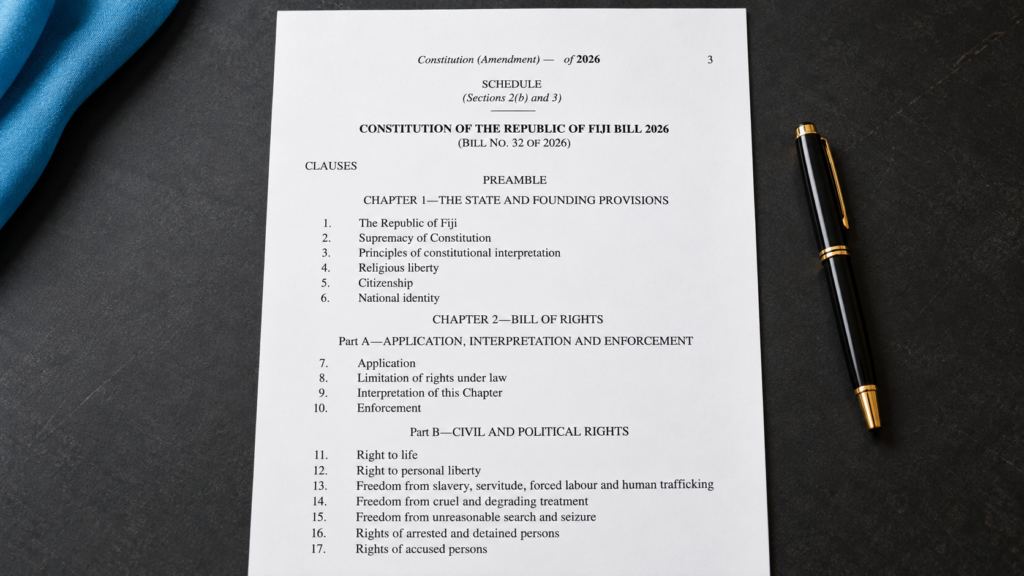
Clause 1(2) of the Constitution Amendment Bill expressly states:
“This Act comes into force on 31 March 2028.”
Section 211(3), which supposedly allows the President to bring that date forward, is contained inside the Schedule to that same Act. Clause 3(3) expressly says:
“the Schedule to this Act shall be construed and have effect as part of this Act.”
This creates an obvious circularity. The President’s power to commence the new Constitution early is itself only contained in the new Constitution. So how can the President use that power before the new Constitution is already in force?
Therefore, section 211(3) does not acquire legal force until the Act itself commences on 31 March 2028.
There is another point. This is not a personal discretion of the President. Under the present Constitution, section 82 says the President acts only on advice of Cabinet, a Minister or another constitutionally prescribed authority. The proposed Constitution similarly says the President acts on advice and, where legislation does not specify whose advice, Cabinet is the source of that advice. So even if section 211(3) can somehow operate before 31 March 2028, early commencement would effectively be an executive decision implemented through the President.
Against that background, there are four main scenarios.
Scenario 1: No early commencement, Constitution commences on 31 March 2028
This is the straightforward scenario. The 2013 Constitution remains operative through the next general election. The election takes place no later than 6 February 2027, under the existing constitutional framework. A new Parliament is elected in 2027. When the new Constitution commences on 31 March 2028, that new Parliament becomes the “first Parliament” for transitional purposes.
Section 219 says “the Parliament in existence immediately before the commencement (the ‘first Parliament’) continues…” and expressly says its maximum term remains four years under section 58 of the 2013 Constitution.
There is no basis, or possibility, here for delaying the 2027 election. Indeed, the structure of the transitional provisions makes clear that the ordinary scheme of the Constitution contemplates the 2027 election taking place before the new Constitution commences.
Scenario 2: Constitution commences before Parliament expires, for example 20 December 2026
Suppose the Constitution is somehow brought into force on 20 December 2026, four days before the present Parliament reaches the end of its four-year term. Section 219 would capture the existing Parliament and convert it into the transitional House of Representatives.
But importantly, section 219(2) says:
“the maximum term of the first Parliament remains 4 years from the date of the first meeting of the first Parliament.”
The current Parliament therefore does not suddenly acquire the five-year term contained in the new Constitution. Its existing four-year term remains. The current Parliament first sat on 24 December 2022. Therefore, in this scenario, Parliament will expire on 24 December 2026, four days later. An election must still follow.
Even the emergency provisions provide no obvious escape route. Section 201 allows an extension during a state of emergency where the term of a House is due to expire under section 66, and limits any extension to 12 months. The transitional Parliament, however, remains expressly governed by section 58 of the 2013 Constitution.
Scenario 3: Parliament expires on 24 December 2026, but no writ has yet been issued
This is the most problematic scenario.
Assume Parliament reaches the end of its term on 24 December 2026. No election writ has yet been issued. The President then purports to commence the new Constitution before the writ is issued. On the literal wording of section 59 of the 2013 Constitution, the writ must issue “within 7 days” of expiry, which creates a possible period extending into late December, potentially up to 31 December 2026.
The constitutional problem is this. Section 219 applies to “the Parliament in existence immediately before the commencement”. But Parliament has already expired. There may therefore be no Parliament for section 219 to transition.
Section 227 may not solve the problem either. It says:
“A process for the appointment, nomination, election or selection of a person into a public office that was commenced before the commencement may continue after the commencement.”
But if no writ has been issued, there is a serious argument that the election process has not yet commenced.
Yet section 221 expressly says:
“From the commencement, the Prime Minister and other Ministers appointed under the 2013 Constitution are taken to be the Prime Minister and Ministers appointed under this Constitution.”
So the Executive is expressly carried across.
The new Constitution does contain its own requirement that a writ “must be issued within 7 days” of expiry or dissolution of the House. But the body that expired was Parliament under the 2013 Constitution. There may never have been a House of Representatives under the new Constitution whose term expired.
Worse, once the new Constitution commences, section 64 establishes an entirely different electoral system involving constituency seats, first-past-the-post elections and party-list seats. Those arrangements may not be ready to operate.
This could create a constitutional vacuum: Parliament has expired, the old election has not commenced, the new electoral system may not yet be operational, but the Prime Minister and Ministers continue in office.
This is the most problematic scenario. If this gap were exploited unscrupulously, Members of Parliament could cease to hold office when Parliament expires, while section 221 carries the Prime Minister and Cabinet across into the new constitutional order. Put simply: Parliament could disappear, while Cabinet survives. The most risky period, therefore, is between 24 and 31 December 2026.
Scenario 4: Writ issued on or before 24 December 2026, Constitution commences before polling
Now suppose the writ has already been issued, but the new Constitution is brought into force sometime between 24 December 2026 and polling day, which could be as late as 6 February 2027.
This situation is much less problematic. Section 227 allows an election process already commenced to continue. Section 218 also says registered voters remain registered for the next general election.
Section 115 further provides: “Upon the issue of the writ for the general election, the Government continues in office in a caretaker capacity…” Most significantly, even where a state of emergency exists after dissolution, section 201 expressly states: “the general election must proceed”.
Once the election has commenced, the constitutional text therefore points strongly towards it continuing.
Conclusion
The Fiji Government Draft Constitution contains no express power to cancel the next election. The danger lies in the narrow window after Parliament has expired but before the election process has formally commenced, when the early-commencement provision could create a serious constitutional vacuum. That provision is itself circular and legally uncertain.
Something as fundamental as the people’s right to elect their Government should not depend on litigation over these ambiguities after Parliament has already expired. The Bill should make absolutely clear that any general election due or commenced under the 2013 Constitution must proceed notwithstanding commencement of the new Constitution, and that the new Constitution cannot be brought into force between the expiry or dissolution of Parliament and completion of the ensuing general election.
There is an even simpler solution: remove section 211(3). The Constitution already provides a clear commencement date of 31 March 2028. Removing the power to proclaim an earlier date would eliminate the circularity, close the transitional gap, and ensure that the 2027 election proceeds under the existing constitutional framework before the new Constitution comes into force.
That would also preserve the sequence the transitional provisions appear designed to accommodate: the 2027 election is held, a new Parliament is elected, and the new Constitution subsequently commences.