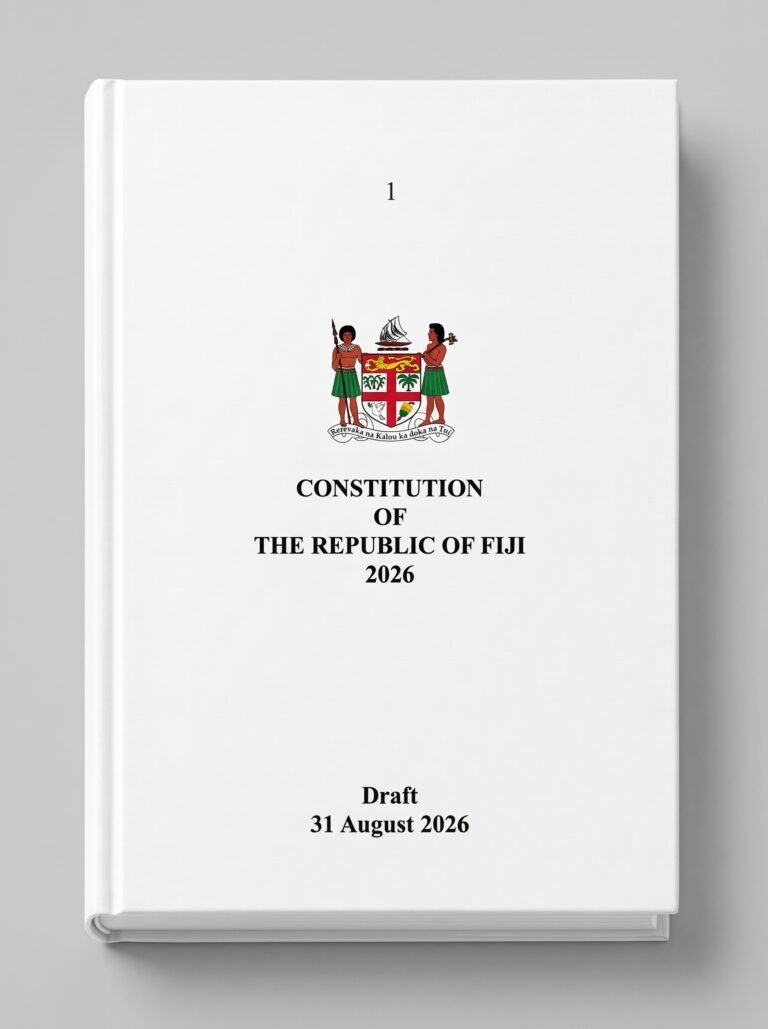
The Centre for Democracy & Dialogue is undertaking a detailed assessment of the Constitution Review Commission Report 2026 and the accompanying draft Constitution and will release a comprehensive analysis of the proposed changes shortly.
CDD Chief Executive Officer Nilesh Lal said the organisation’s preliminary assessment is that the draft contains many significant and welcome constitutional reforms, addressing many longstanding weaknesses in the 2013 Constitution, particularly the concentration of executive power and weaknesses in institutional independence and accountability.
“Dialogue Fiji made 22 substantive proposals in its submission to the Commission. Our preliminary analysis finds that around 17 of those 22 proposals are reflected to some degree in the draft Constitution, including 12 that are substantially or fully reflected,” Mr Lal said.
“This is significant. Many of the reforms we advocated were aimed at dispersing concentrated power, strengthening independent institutions and improving democratic accountability.”
Mr Lal said the draft substantially reflects DF proposals to depoliticise constitutional appointments, strengthen the independence of the Public Service Commission, cap Cabinet at 15 members, limit a Prime Minister to two terms, strengthen the Bill of Rights and the test for limiting rights, strengthen access to information, strengthen judicial independence, constitutionally entrench the Public Accounts Committee with an Opposition chair, retain the four-year parliamentary term, restrict the use of expedited legislation, retain secularism and equal citizenship, and strengthen constitutional recognition of local government.
“These are substantial constitutional improvements and CDD believes they should be acknowledged and preserved,” Mr Lal said.
However, CDD’s preliminary review has also identified a small number of potentially fundamental flaws and democratic regressions that require much closer scrutiny.
“One of the most regressive elements is the proposed move away from a PR to an MMP system when the overwhelming evidence globally is that PR systems are more representative and fair, and highly desirable for ethnically divided societies. The CRC’s proposed system is dominated by 26 first-past-the-post constituency seats and only 15 compensatory list seats. The CRC describes its proposal as MMP, but the design is heavily majoritarian in effect,” Mr Lal said.
“CDD has serious reservations about replacing Fiji’s existing national PR system with a model in which almost two-thirds of elected seats would come from single-member constituencies. This would represent a significant change in the way votes are translated into representation and warrants much deeper scrutiny, particularly in a multi-ethnic society with a history of exclusionary governance such as Fiji.”
CDD is also concerned about the proposed reintroduction of unelected elements into the legislature through a 19-member Senate containing members appointed by political and traditional institutions.
“We need to ask very carefully whether a country that currently has a fully elected national legislature should move backwards to a system in which a substantial part of Parliament is not directly elected by citizens,” Mr Lal said.
CDD also considers the proposed reopening of the divisive debate about the common national identity of “Fijian” to be a significant concern.
“Our submission strongly supported retaining ‘Fijian’ permanently as the common civic identity of all citizens while fully protecting the distinct Indigenous identity of the iTaukei people and the identities of all other communities. Reopening the common national identity risks weakening an important principle of common and equal citizenship.”
Mr Lal said CDD would also closely examine provisions that give constitutionally entrenched political and legislative roles to traditional or ethnically defined institutions.
“Recognition and protection of Indigenous rights, culture, land and traditional institutions are entirely compatible with equal citizenship. The question is whether those protections require unelected institutions to exercise substantial authority within the national political system.”
CDD said its full assessment will distinguish between provisions that strengthen constitutional democracy, proposals that involve legitimate policy trade-offs, and provisions that it considers potentially regressive or harmful.
“The Commission has produced a substantial body of work and many of its recommendations deserve careful consideration. But constitutional reform cannot be approached as an all-or-nothing package,” Mr Lal said.
“We should preserve the reforms that strengthen rights, accountability and institutional independence, while subjecting the provisions that alter electoral representation, the composition of Parliament, national identity and the role of unelected institutions to much deeper public scrutiny.”